


The Artist
Ryan Martin
Ryan Martin lives and works in the San Francisco Bay Area where he attended the California College of the Arts. Through painting and drawing, Martin creates surreal, dream-like compositions of his subjects. He is influenced by his Native American (Mexican/Seri) and Russian heritage through painting reinterpretations of war bonnets and kokoshniks haloing his subjects.

Step 1
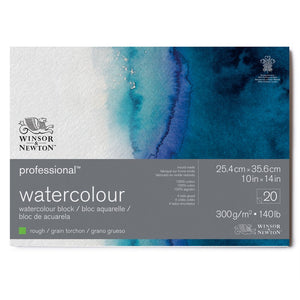
A third of the way down from the top of the paper, lightly sketch in a jagged line creating a mountain range silhouette. Draw in a straight horizontal line, a third of the way up from the bottom of the paper, to represent the edge of a lake. It helps to keep the drawing simple, to allow more freedom when creating watercolour
blooms.

Step 2
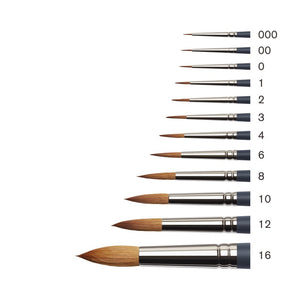
Squeeze a dot of Smalt (Dumont’s Blue) Professional Watercolour paint onto the palette. Use a #8 Professional Watercolour Synthetic Sable brush, with water only, to wet the entire sky and the mountain range section, but not the lake. Ensure the sky and mountain range has a consistent layer of moisture without any puddles.
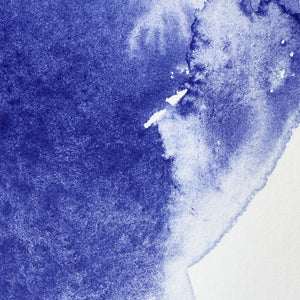
With a wet brush, touch only the brush tip into the Smalt (Dumont’s Blue) paint. On a clear part of the palette, swirl the wet brush around to dissolve the blue paint on the brush tip to create a small puddle of light blue. Then take the brush with the diluted watercolour and dab tiny amounts of paint along the top of the sky. When the watercolour on the tip of the brush touches the wet paper it will bloom outward. Allow the color to blend organically across the sky. The watercolour block can be tilted to help control the direction of the bleed across the sky. Continue downward, dabbing the brush into the mountain range. The brush will lose paint with each dab, this will leave the top of the sky darker than the bottom portion of the sky and the mountain range will appear even lighter. The goal with this technique is to keep from overworking the paint and allowing it to flow throughout the wet paper to create effortless organic forms.
Make sure the painting is completely dry before continuing the
next step

Step 3
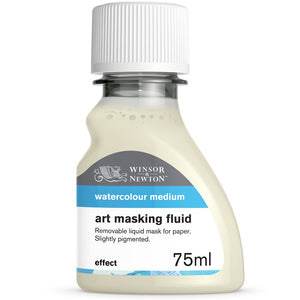
Pour a small amount of Art Masking Fluid onto the palette. At
the tops of the mountain range use a small watercolour brush
to apply Art Masking Fluid to one side of the mountain tops
to create snowcaps. Then use the Art Masking Fluid to create
short horizontal strokes across the lake surface. The uses for
Art Masking Fluid are endless. Artists can mask snowy trees,
silhouettes of geese on the lake, snow falling from the sky,
anything they can dream up.
Allow the Art Masking Fluid to dry completely before proceeding
to the next step.

Step 4
Wet the mountain range section with an even layer of water. Use
the wet tip of the brush to pick up a small amount (about the size
of a grain of rice), of Smalt (Dumont’s Blue). Swirl the wet brush
with paint onto the palette, to create a darker blue watercolor
mixture. Pick up more watercolour and water mixture with the
brush than was used in the sky. Touch the brush across the top
ridge of the mountains, allowing the paint blooms to be darker
than the sky. Tilt the watercolour block as needed, to help the
paint bleed downward into the mountains. Enjoy the interplay
of controlled highlights and spontaneous bloom effects in your
mountain landscape.
Allow the paint to dry completely before going to the next step.

Step 5
Use the larger watercolour brush to wet the entire lake section with water only. Load the tip of the watercolor brush with paint. This time, streak it across the lake section of the painting, several times. Create quick stripes over the wet section of the lake by pulling the brush back and forth. Be sure to carry the strokes over the Art Masking Fluid in the lake.

Step 6
Once the paper is thoroughly dry, gently rub off the dried Art Masking Fluid using an eraser or your fingers. This reveals the preserved highlights.

Step 7
Add details to the lake using darker shades of Smalt (Dumont’s Blue) by adding more watercolor paint to less water. Add trees along the lakeshore using a light watercolour value to create depth and atmosphere. Creating watercolour blooms is great for creating organic forms found in nature, eroded hills, tree lines, coral, clouds, nebulas, the possibilities are endless.

![W&N COTMAN WATER COLOURS H/P LEMON YELLOW HUE [COMPOSITE] 094376901658](http://uk.winsornewton.com/cdn/shop/files/10262.jpg?crop=center&v=1714069205&width=20)
![W&N COTMAN [SWATCH] LEMON YELLOW HUE](http://uk.winsornewton.com/cdn/shop/files/2922.jpg?crop=center&v=1714069205&width=20)

![WN PROMARKER COOL GREY 3 [COMPOSITE] 884955041406](http://uk.winsornewton.com/cdn/shop/files/77586.jpg?crop=center&v=1741263144&width=20)
![W&N DESIGNERS GOUACHE 14ML ZINC WHITE [COMPOSITE] 50947195](http://uk.winsornewton.com/cdn/shop/files/10437.jpg?crop=center&v=1717586081&width=20)
![W&N DESIGNERS GOUACHE [SWATCH] ZINC WHITE](http://uk.winsornewton.com/cdn/shop/files/3022.jpg?crop=center&v=1714143175&width=20)
![W&N GALERIA ACRYLIC TUBE 60ML TITAN WHITE 08 [COMPOSITE] 094376914061](http://uk.winsornewton.com/cdn/shop/files/9396.jpg?crop=center&v=1714072593&width=20)
![W&N GALERIA [SWATCH] TITANIUM WHITE](http://uk.winsornewton.com/cdn/shop/files/3097.jpg?crop=center&v=1714072593&width=20)

![W&N BLACK FINELINER LS 0.1 [CAP ON]](http://uk.winsornewton.com/cdn/shop/files/64128.jpg?crop=center&v=1736866967&width=20)
![WN COTMAN 8 PC FLORAL POCKET BOX [OPEN WITH STICKER] 884955081129](http://uk.winsornewton.com/cdn/shop/files/132624.jpg?crop=center&v=1761839596&width=20)
![W&N COTMAN WATERCOLOUR 8HP FLORAL POCKET SET [FRONT]](http://uk.winsornewton.com/cdn/shop/files/97499.jpg?crop=center&v=1760698026&width=20)